
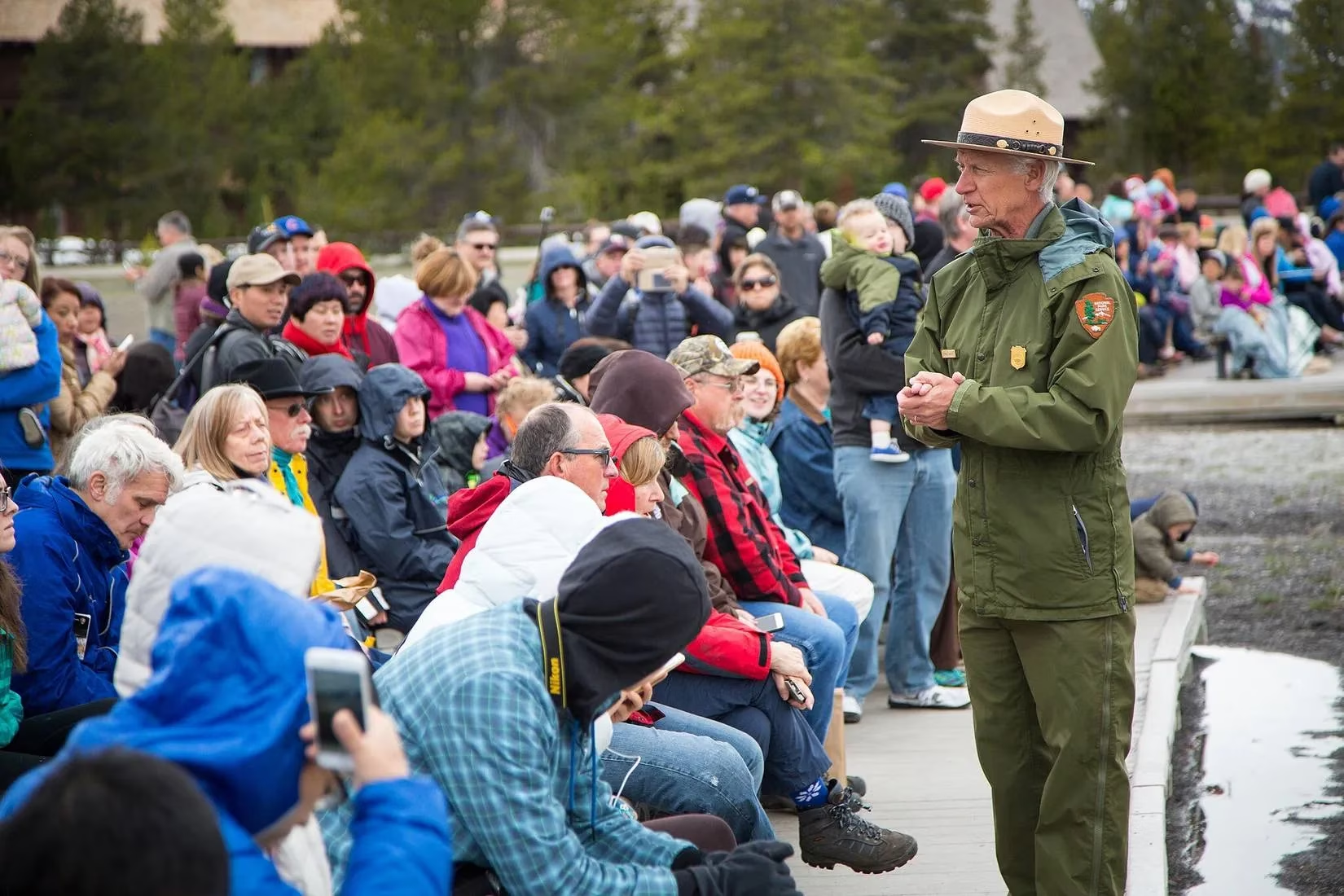
Standing on the boardwalk near Old Faithful, feeling the ground shudder ever so slightly as the geyser prepared for its spectacular display, I was reminded that Yellowstone is a living, breathing entity. It’s not just a postcard-perfect landscape; it’s a sprawling, volcanic heart that beats with a rhythm we are only just beginning to decipher. For years, I, like most visitors, marveled at the obvious—the erupting geysers, the bubbling mud pots, the vast caldera. But beneath our feet, a far more subtle conversation was happening, one spoken in whispers of seismic waves too faint for traditional ears to hear. That is, until now.
As a regular visitor since the early 2020s, I've followed the park's seismic story with keen interest. We all know about the big ones, the tremors that make headlines. But the real story, I've learned, is in the silence between the booms. For decades, the United States Geological Survey's (USGS) network of seismometers has been the park's stethoscope. Yet, this system had its limitations. In winter, the solar panels powering remote stations could become snow-covered tombs, rendering the instruments temporarily deaf. More critically, countless minor earthquakes—the park's constant, low-grade murmurs—simply slipped through the net, too small to be cataloged by traditional methods. It was like trying to understand a symphony by only listening to the crescendos, missing the intricate harmonies of the violins and woodwinds that give the piece its true depth.
The breakthrough, announced in late 2025 and fully operational by 2026, didn't come from a bigger stethoscope, but from a new kind of listener. The USGS began employing advanced machine learning algorithms to sift through 15 years of archived seismic data. This wasn't about replacing human scientists; it was about giving them a super-powered microscope for sound. The AI, acting like a master cryptographer, was trained to recognize the unique signatures of earthquake waves that had previously been dismissed as background noise—the geologic equivalent of finding distinct whispers in a roaring crowd.
The results were nothing short of revolutionary. The refined analysis, which also incorporated a sophisticated 3D model of the subsurface, successfully identified and pinpointed 67,433 previously missed earthquakes over that 15-year span. This new catalog is no mere list; it’s a detailed map of hidden conversations. It reveals how seismic swarms are connected in space and time, showing patterns of stress migration through the volcanic plumbing like ink diffusing through water. For researchers, this is a paradigm shift. We’re no longer just watching the volcano’s pulse; we’re starting to trace the flow of its blood.
Of course, the mention of "AI" sent a minor tremor through the park's community of enthusiasts. On social media, concerns bubbled up like a new mud pot. "Do we really trust AI?" one person questioned, while another quipped about volcanoes outlasting "the AI hype." The reaction was understandable—in a place governed by ancient, primal forces, the idea of silicon-based intelligence can feel alien. The USGS was quick to clarify and educate. They explained that the tool is specifically machine learning, a subset of AI focused on pattern recognition. It’s not a sentient overseer but a sophisticated filter, meticulously tested and validated. "It's really about pattern recognition," they noted, "seeing patterns that are often too subtle for traditional approaches." In essence, they’ve given their scientists a new lens, one that lets them see the faint, star-like tremors in Yellowstone’s vast seismic sky.
So, what does this mean for us, the visitors standing on the boardwalks? Firstly, it means a profoundly deeper understanding of the park we love. Each of those 67,433 relocated quakes is a data point that sharpens our picture of the magma chambers, hydrothermal systems, and fault lines hidden miles below. This long-term, high-definition monitoring is our greatest tool for stewardship. It allows scientists to distinguish between normal, healthy rumblings and potential precursors to more significant change. The data is a shield, not a source of alarm. As the USGS puts it, these investments in monitoring are paying off, "continuing to unveil active volcanic, hydrothermal, and tectonic processes hidden deep beneath the surface."
Looking to the future, this is just the beginning. The seismic record of Yellowstone is growing longer and richer every day. With machine learning as a constant companion in the analysis room, our comprehension will continue to evolve. The park will always have surprises in store—its behavior is as complex and unpredictable as a weather system. But now, we have a better barometer. We are learning to listen to the full symphony of this incredible landscape, from the deepest double-bass groans of tectonic shifts to the piccoloto chirps of minor fractures. It’s a reminder that in Yellowstone, even the silence is full of sound, and now, finally, we have the ears to hear it.
Leave a Comment
Comments